Home | Contacts | Mitton Cross | Activities

|
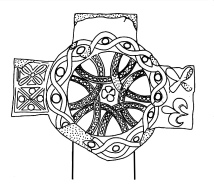
The Mitton CrossToday the hamlet of Mitton is a suburb of Tewkesbury, but in the medieval period it was an independent community and was part of Worcestershire. In the Domesday Survey of 1086 Mitton consisted of an estate of one hide, belonging to the Bishop of Worcester. It appears that during the 15th or 16th century Mitton was largely depopulated and shrunk to one large farmstead (Mitton Manor) and a few cottages. Mitton Chapel Mitton formerly posessed a medieval chapel (SO 903 339) dedicated to the festival of the Holy Cross (14th September). The existence of the chapel was first documented in 1287, and in 1427 its congregation obtained the right to establish their own cemetery, while remaining part of Bredon parish. Latterly the chapel consisted of a nave, chancel and west tower, and was apparently still roofed in the 17th century. It was shown on an estate map of 1702, but by 1775 it had apparently closed and become ruinous. In 1966 the site of the chapel was redeveloped for housing, this destruction revealed at least eight fragments of masonry, including window heads and jambs, most of which ended up in local rockeries. This development also revealed a cross-head, which is now displayed in Bredon church. The Cross-head The cross-head is carved from a single block of Oolitic limestone, its length (from top to bottom) is 395mm, and its width is 485mm (about 15-1/2" by 19"). It has one decorated face, the rear one being very irregular, probably due to the cross-head having been split lengthways into two portions. The unweathered and crisp finish of the decorated face of the cross-head suggests that it may have been split during the medieval period, possibly to facilitate its reuse within the fabric of the medieval chapel. A number of the surviving fragments of cross-heads and shafts in the midlands have been incorporated into church walls. The cross-head has three short arms and its fourth arm is badly broken, where it presumably joined the shaft of the cross. This type of cross-head is sometimes referred to as 'circle-headed' with unpierced spandrels. The top arm of the decorated face is blank. The right-hand arm is decorated with one fleur-de-lys (lily) and a four-petalled flower. The left-hand arm of the cross is decorated with a four-petalled flower or a sprig of foliage and a small square divided by diagonal ridges into four triangles, each containing a circular bead or pellet. The outer portion of the centre of the cross is defined by a circular band of two interlaced strips forming a braided decoration. Each of the ovals within the braiding contains a single bead. Inside the braiding are a series of seven semi-circular overlapping strips, making an interlaced decoration. In the centre of the cross is a four petalled or quatrefoil flower. The Mitton cross-head can be dated on stylistic grounds to circa 1150-1200, as very similar decorated motifs occur in a number of West Midland churches of this date. Quatrefoil flower or foliage decorations were a common decorative motif on late 12th century church doors and arches. The cross-head was described in the Courtauld Institute Survey of British Romanesque Sculpture as early 12th century. Dr Ron Baxter of the Courtauld Institute suggests that the cross dates from circa 1150-60 as it would be unusual to find examples af chip-carved work after this date (thanks to Dr Baxter for his opinion and for supplying the unpublished data from the 1994 Worcestershire Survey by the late Geoff Pearson). The Mitton cross-head is architecturally important as locally there are few examples of either Saxon or Norman cross-heads; the prayer crosses which are found in the grounds of some local churches are all of late medieval date. Research to date has failed to locate any other examples of 12th century cross-heads in the West Midlands. The best-known local cross-head is from Cropthorne, Worcestershire, this splendid 9th century artifact was formerly built into the fabric of the church. Archbishop Theodore (AD 669-690) had allowed priests to say mass 'in the field' in the absence of of a church. A century later, in the life of St Willibald, it was stated that it was the custom on the estates of many lords that there was no church, but only a cross raised on high for the daily service of prayer. Perhaps during the 12th century when many local parish churches were being constructed, the small agrarian community of Mitton (shown by the Domesday hidage) could not afford to build a church, but as a first step raised a stone cross, which was later replaced by a stone-built chapel. At this time the cross might have been demolished and fragments of it incorporated into the fabric of the new building. With grateful thanks to the authors, Bruce Watson and Richard Sermon, for permission to reproduce the above article, which originally appeared in the Spring 2002 edition of the Worcestershire Recorder, the newsletter of the Worcestershire Archeological Society.
|